
With a model nearby
For 1/2 + 1/4, a worked example shows how to rewrite 1/2 as 2/4. Your child follows that step and gets 3/4.
A local Mathnasium resource
Start by comparing the help available during homework with what your child can do independently. A correct finished page may not show which steps needed a hint, an example or a correction.
Look at the work together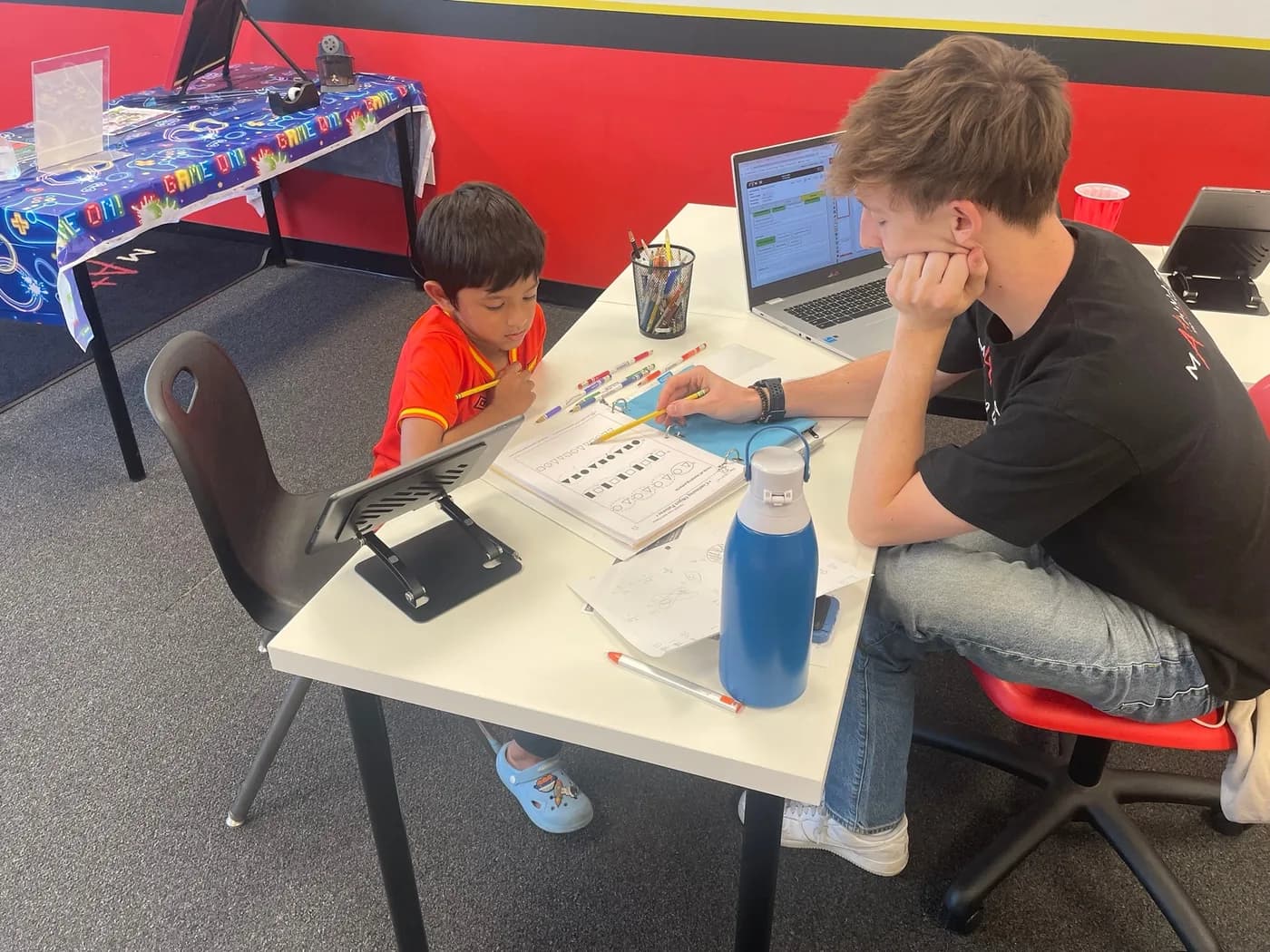
Look beyond the score
Homework and tests can show different parts of learning. Compare the conditions and the actual work before deciding what support your child needs.
A useful first conversation
A parent might say, “You got this one right at home. What helped you get started?” Your child may have chosen a method on their own, looked at a similar example, or needed someone to point out the next step. Those are useful differences to notice, without treating help as a failure.
Then compare a homework example and a recent test with the teacher. Did your child choose a method but make a calculation error? Start with the wrong operation? Leave a question blank? Ask whether the same difficulty appears in independent classwork. A comment such as “needs help getting started” is a reason to ask which step needs help, rather than a conclusion about the whole subject.
Set up practice with your child: choose a workable time, have supplies ready and reduce interruptions. That is different from choosing the operation or supplying each next step. Notice which kind of help your child used. Keep the supports the teacher expects them to have, and avoid turning home into another testing room.
One example, two situations
For 1/2 + 1/4, a worked example shows how to rewrite 1/2 as 2/4. Your child follows that step and gets 3/4.
For 2/3 + 1/6, your child needs to decide to use sixths. Rewriting 2/3 as 4/6 gives 4/6 + 1/6 = 5/6.
“How did you decide which fractions to use?” The explanation can help you see whether choosing the first step still needs support.
Match support to the concern
If your child needs help with the same underlying math skill in both settings, discuss support for that skill. If they can work independently at home but struggle on tests, ask the teacher about differences in question wording, mixed topics, tools and time allowed. Do not assume that every lower test score has the same cause.
Choose a small, observable goal together. For the fraction example, it might be “choose a common denominator and explain the first step without someone telling me which denominator to use.” Ask the teacher what work would show progress toward that goal. This gives you something more specific to look for than a completed worksheet or the next grade alone.
At our Mathnasium centers in Clifton Park, Loudonville, Niskayuna and Westmere, an assessment identifies individual math gaps and helps us build a personalized learning plan. Each visit balances current homework with work on missing skills, plus fun and encouragement.
That can provide a starting point for math instruction. It is not a promise of a particular test score. Read how our assessment finds your child's starting point, or choose a center below to talk through your concern with its Center Director.
Common questions
You can still help. Notice what kind of help is needed, and ask the teacher how to support practice at home. Keep any supports your child is meant to use; making homework harder is not the goal.
The grade alone does not explain what happened. Look at the questions, the written work and any teacher feedback. A missed calculation, difficulty choosing a method and an unanswered question give you different things to discuss.
That is useful information to share with the teacher. Ask how the test differed from the practice: the wording, mix of topics, available tools or time allowed. Avoid deciding on a cause from the score alone.
An assessment helps identify your child's math strengths and missing skills so an individual learning plan can begin in the right place. It does not, by itself, explain every reason for a difference between homework and test results.
Your next step
Choose a local center to schedule an assessment or a conversation with its Center Director.
Select a center to see your booking choices.