
Ratios
Ask your child what each number represents. If a recipe has 2 cups of juice for 3 cups of water, ask what would need to change to keep the same mix.
A middle-school transition guide
The work shifts from doing calculations to using arithmetic ideas in new forms: ratios, signed numbers, expressions, equations and data. A concrete example can make the next conversation more useful.
See what changes in middle school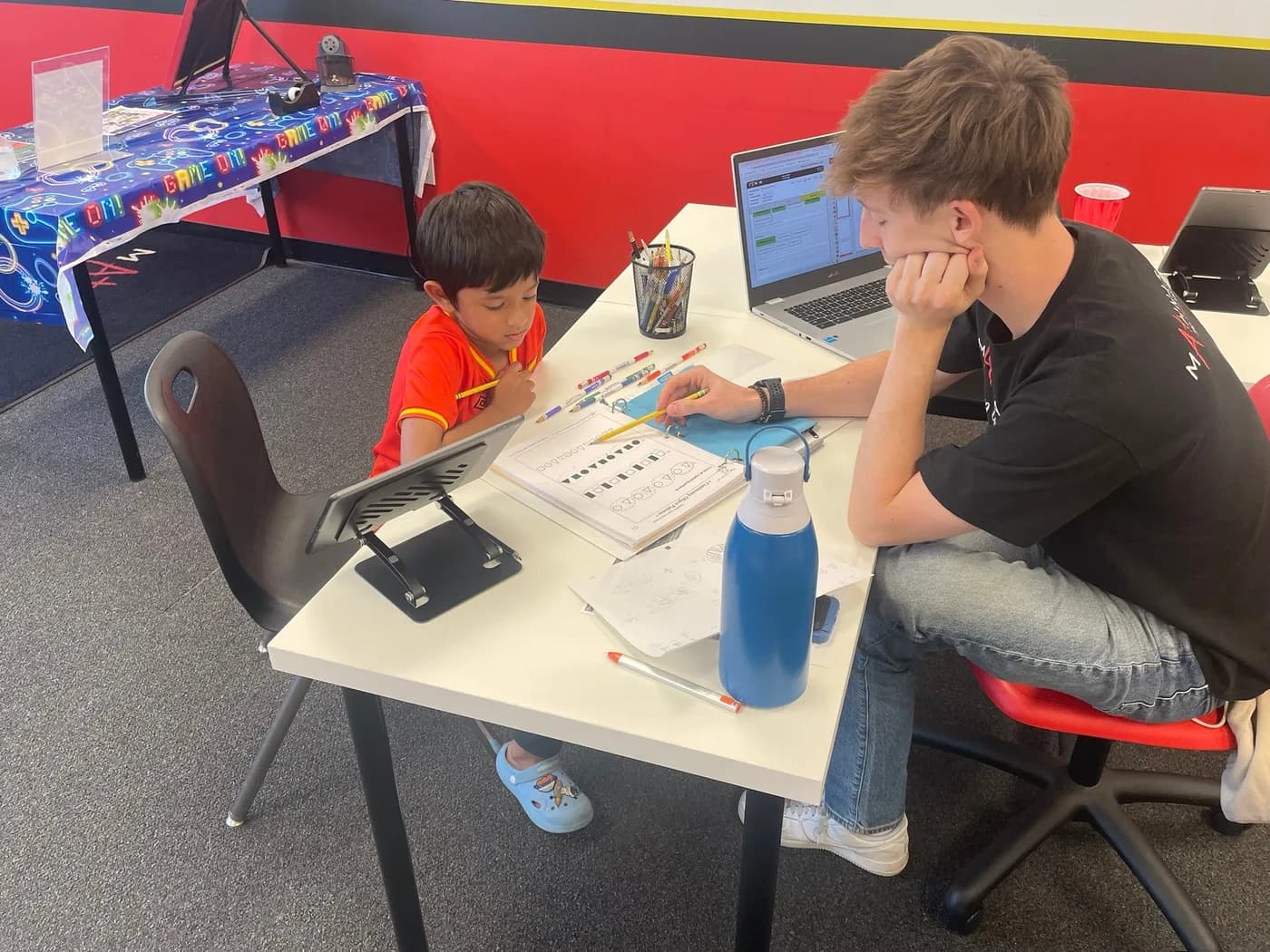
The direct answer
Middle-school math often feels different because students are asked to explain relationships and use ideas across several steps, not simply complete a familiar calculation.
What changes
New York's Grade 6 mathematics standards include ratios and proportional relationships, the number system, expressions and equations, and statistics and probability. Those strands build on arithmetic, but they ask students to use it in less concrete ways.
Read New York's mathematics learning standards.
For example, a student may know how to multiply 2 by 3. A ratio such as 2:3 asks a different question: how do two quantities compare, and why is 4:6 an equivalent comparison? The calculation is only part of the reasoning.
Signed numbers can create a similar shift. On a number line, -3 + 5 means starting at negative three and moving five units right, so the result is two. Drawing or describing the movement can reveal whether the difficulty is the rule, the number line, or both.
Bring the abstraction down to earth
Ask your child what each number represents. If a recipe has 2 cups of juice for 3 cups of water, ask what would need to change to keep the same mix.
Use a number line or a temperature change to discuss direction. Ask where a calculation starts and what each operation tells the number to do.
For 3(x + 2), ask what the parentheses mean before simplifying. A student may know multiplication facts but still need help representing the grouped quantity.
A useful next conversation
Bring a current assignment, quiz, or example your child can talk through. Instead of asking only for an answer, ask, “What does this number mean?” or “What made you choose that step?” Their explanation can show whether they are meeting a new idea, need a different representation, or want to revisit an earlier skill.
That distinction matters. A student who understands a ratio but loses track of fraction multiplication needs a different conversation from one who does not yet see what a ratio describes. For a broader look at earlier skills affecting current work, read about math gaps. For a later transition, read about Algebra readiness.
Support at our local centers
At Mathnasium of Clifton Park, Loudonville, Niskayuna and Westmere, an assessment helps us identify skills a student is missing and build an individual learning plan. Generally, it covers material they should have mastered by the end of the previous school year. Its purpose is to find a starting point, not give a grade.
Each visit balances homework support, work on missing skills, and fun and encouragement. Bring a middle-school example that prompted your concern so you and the Center Director can discuss what support might fit.
Common questions
Sometimes an earlier skill matters, but a harder assignment does not prove there is a gap. Middle-school work also asks students to connect familiar arithmetic to new representations and multi-step reasoning. A specific example helps identify the right question.
Ask them to show where the work first stopped making sense. It could be choosing an operation, placing a negative number on a number line, translating words into an expression, or keeping track of several steps.
No. A challenging unit is useful information, not a prediction. Talk about the particular ideas involved and whether an earlier skill or the new representation needs more attention.
Your next step
Choose a local center to schedule an assessment or a conversation with its Center Director.
Select a center to see your booking choices.